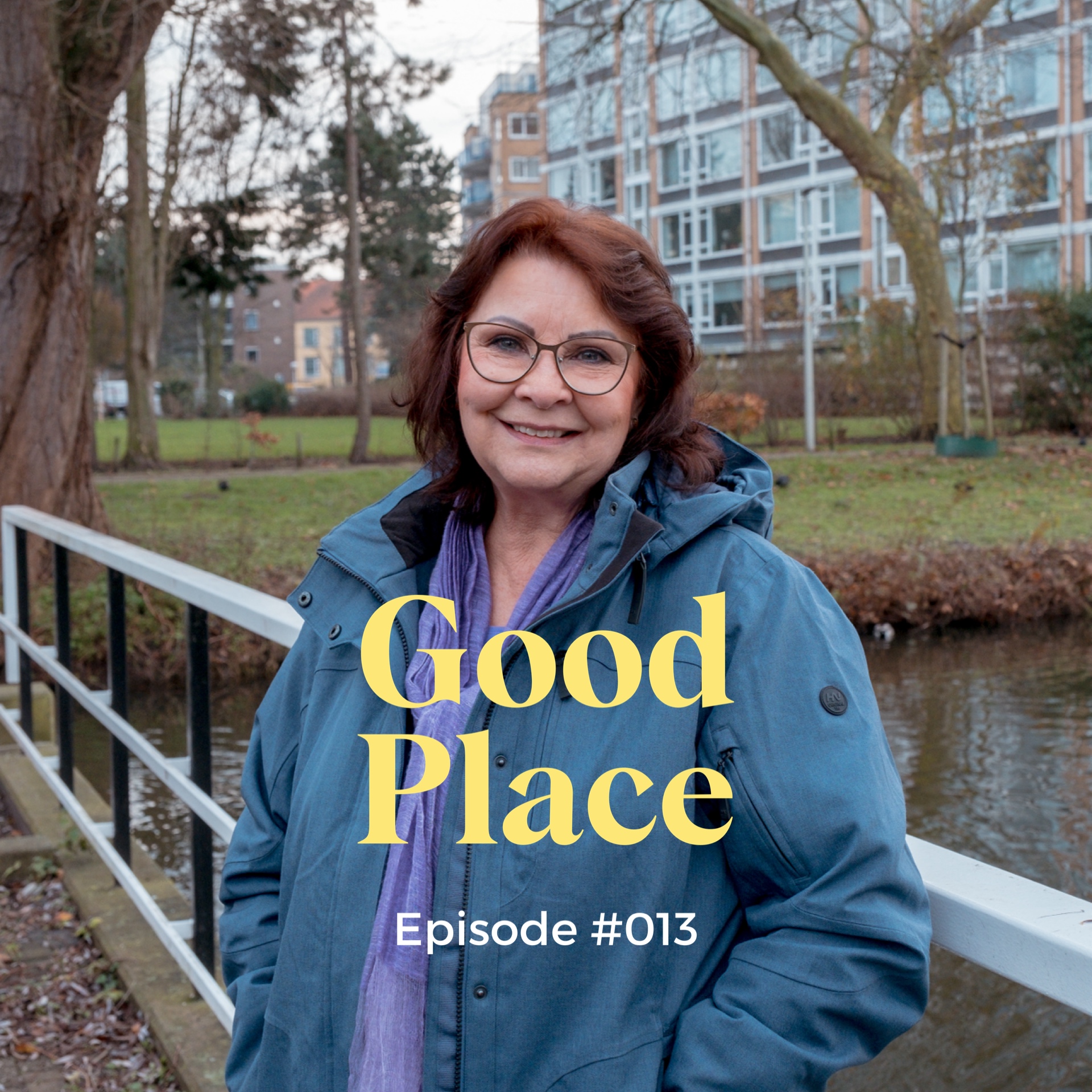
Thirty-seven years into the Netherlands, a British expat on marrying a man after three days, building a landing pad for newcomers, and a definition of a good place that has nothing to do with money.
Chezzie Bergman met her husband on a Friday, in England. They were married the following Monday. She moved to the Netherlands shortly after and has lived in the same corner of The Hague, Waldeck, ever since, thirty-seven years and counting, in a flat above three ice cream shops and three cake shops, which she mentions with the satisfaction of someone who knows exactly how good she has it.
A landing pad for people who've just arrived
Chezzie's path into community work started almost by accident, minding a neighbor's son and killing time at a place called The Hungry Mind, a community center behind the international school originally built as a bridge between the local Dutch neighborhood and the influx of international families arriving with it. Eight years on, she's its chair, and the thing she's proudest of isn't the coffee mornings or the workshops. It's the first few minutes someone walks through the door.
She described it as a landing pad, deliberately. Moving somewhere without speaking the language, without a single person you know, having just finally made friends in your last city before getting uprooted again, is disorienting in a way people rarely plan for. The Hungry Mind exists to shortcut that disorientation: someone greets you, asks how you are, invites you to sit, to join a workshop, to hear your own language spoken back to you after months of not hearing it at all. "That's what we're trying to do," she said, "make everybody feel at home."
Kindness as a practice, not a mood
What struck me most about Chezzie wasn't the volunteering itself, considerable as it is, but how deliberately she treats kindness as something you do rather than something you feel. She smiles at strangers on the tram, on purpose, repeatedly, until some of them eventually sit down and start talking. Her neighbors, she said, didn't become close by accident; a culture of genuinely helping each other, food delivered when someone's unwell, car keys handed over without hesitation, built itself over years because enough people decided to be kind first and see what happened.
She was candid that this isn't everyone's instinct. One neighbor who moved away told her they'd never have left if they'd understood what they were giving up. Another neighbor's first interaction in the area was someone knocking on their door, not to welcome them, but to complain about a parking spot. Community, in other words, isn't automatic anywhere. Chezzie's version of it is the product of three decades of specific, repeated effort, not the neighborhood's default setting.
A twenty-five-year friendship that isn't about her
Alongside The Hungry Mind, Chezzie has spent twenty-five years as the pen pal, friend, and now legal guardian of a woman named Anneke, who has a brain injury and the mental age of roughly three. What began as a favor for a friend, since Anneke had no family visiting her, has become one of the steadiest relationships in Chezzie's life. She visits most weekends, has fallen in love, as she put it, with everyone in Anneke's care home, and is stepping back from her chair role at The Hungry Mind partly to have more time for exactly this kind of unglamorous, unpaid devotion.
It's worth noticing what doesn't come up in that story: recognition, reciprocity, anything resembling a return on investment. Chezzie doesn't frame it that way, and it would feel strange to ask her to.
What a good place actually requires
When I asked Chezzie whether she was in a good place, her answer arrived without hesitation and without romanticizing the question. She's happy. She doesn't want for anything. And her definition, when I pushed her on it, turned out to be almost entirely practical: knowing what's in your mailbox before you open it. Not fearing a bill you can't pay. She was blunt that money, dismissed so easily by people who have enough of it, becomes the single most important thing in the world the moment you don't, and she volunteers for a charity precisely because she's seen that gap up close.
Beyond financial security, her second criterion was simpler still: whether you can make someone laugh, and whether someone can make you laugh back. She used to measure a good life by a brand-new car every August, turbocharged, expensive, eventually stolen and never recovered. She doesn't miss it. What she kept instead was a secondhand Renault 5 given to her out of love, which did the same job of getting her from A to B, minus the status, minus the anxiety.
An invitation, not a sermon
Chezzie's closing thought wasn't really advice, more an open door. There's a version of life, she said, that's entirely available at home, Netflix, the sofa, nothing wrong with it. And there's another version, a community center, a charity delivery, a stranger on a tram who might smile back, that asks a little more of you and tends to give more back in return. She wasn't prescribing the second one. She was simply describing what thirty-seven years of choosing it has looked like from the inside: a neighborhood that knows her by name in every shop, a friend she's cared for a quarter of a century, and a mailbox she isn't afraid to open.
Watch the full conversation on YouTube, or listen on Spotify. Want to go deeper into building your own sense of belonging, wherever you live? The Good Place to Start workbook series walks you through it — get it here.
And you? When did you last smile at a stranger on purpose, just to see what happened?