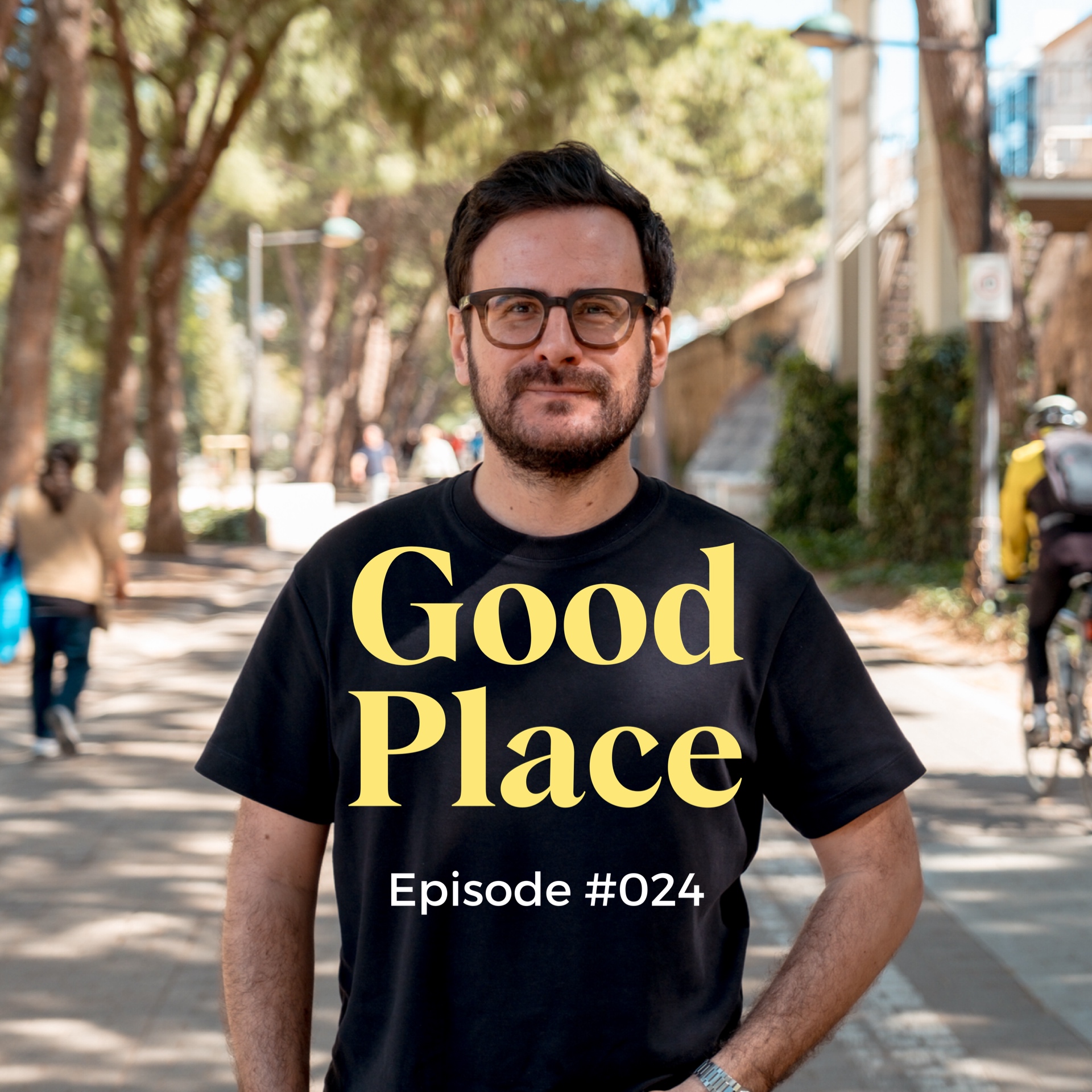

A born-and-raised Valencian placemaker on how a riverbed became a park instead of a highway, what a siesta says about a good public space, and why inclusion has to be defended.
For several weeks I'd been in València asking strangers about the city, and I hadn't yet met someone who was actually born there. Ramon Marrades is, and he also happens to be director of Placemaking Europe, a foundation based in Amsterdam. We sat on a bench in the old Turia riverbed, a park that Ramon thinks tells the story of València better than any museum.
A childhood indoors
Ramon was born in 1986 and grew up in what he calls the worst period for public space in Spanish cities: the car-centric nineties. His childhood was a daily sequence of bus, school, bus, apartment. His parents had chosen a progressive, cooperative school outside the city, surrounded by orchards and farms, where the children spent the day outdoors. But at four o'clock he was put on a bus and delivered home for the rest of the evening. There were playgrounds, he remembers, but they were sad. Friends met in apartments.
That, he says, shaped him as an urbanist: he didn't want it for the next generation. Now there's a playground on nearly every corner of the city, and as a father he benefits from it. Children are back on the street.
Reclaiming a square
One of his first projects came when he opened a small urbanism office with friends in the old town. They worked with a group of parents who wanted to raise their children in the old city, which was unusual. Most couples moved out of the centre when they had kids. The parents created pocket parks from the bottom up. One square, Plaza del Carmen, had a reputation for drug dealing and drinking. Rather than avoid it, the parents and children decided to take it over, by being there in sufficient numbers.
Today, it's full of children, and parents gather by the fence. Ramon notes a quiet innovation of Spanish cities: someone always opens a café with outdoor tables next to a playground, so parents can have a beer while the kids play. The bar owners understood before the real estate agents did.
Staying, leaving and coming back
València, he said, is roughly the size of Amsterdam, but it isn't a financial centre or a capital. More than half his friends live abroad. After the 2008 crisis, many went to the Netherlands, Germany and the UK to find work, and most didn't return. The city is now attracting remote workers and holidaymakers, which is good for culture and public space, but rents are rising fast. It's at a crossroads, he said: it needs affordable housing and good jobs for those who left and those who want to stay.
His own path has been back and forth. He studied in València and Barcelona, nearly stayed away in 2011, and came back because the indignados movement made him want to be part of what was happening. He worked for the local government for four years, left, spent time in Amsterdam and Berlin, and returned a year ago to be near family and friends. He's also an activist, founded an NGO about the city's future, and wrote a book about València's transformation. He expects to have one foot in València and one in the rest of Europe.
A riverbed that nearly became a highway
The story of the park is the part of our conversation I'd take away. After a devastating flood in the 1950s, the authorities of the Franco era diverted the river in the 1960s, a huge engineering project that destroyed natural areas and good farmland to the south. The old riverbed became no man's land: informal housing, kids playing football, even cattle. In the early 1970s, the plan was to turn it into a six-kilometre highway through the city.
It was stopped by civil society. As democracy returned, neighbourhood associations said they wanted the riverbed public and green, and when the first democratically elected government came in, it took that on. The park was built in segments, sensibly and without much show, and grew into what Ramon thinks is the best public park he knows. For him it's also a metaphor for the phases of urban development: the engineering of the 1960s, the bad ideas of the 1970s, the progressive, infrastructure-led thinking of the 1980s and 1990s, and then, at the far end, the shiny buildings of the 2000s, impressive but not rooted in the city's needs.
During Covid, when Spaniards were restricted to a kilometre from home, the riverbed reached almost 70% of the city's population, he said. People used it as a public gym, to dance, to do tai chi. You see Ecuadorian families dancing traditional dances. When Ramon's team starts a project, they ask: who's here, and who's missing? In the riverbed, almost everyone is there.
Inclusion is not guaranteed
Ramon was clear that this isn't permanent. He's critical of the current city government, which relies on far-right support, and says it is restricting NGOs that work with homeless people in the park and has talked about installing hostile architecture to prevent people sleeping there. He finds it especially sad in a place that is an icon of inclusion. Hostile architecture, he says, is not even a solution; it's proven not to work. Inclusivity isn't granted, he said. It needs a government to be its steward, and a society that is active.
The siesta test
When I asked him to define a good place, he used a Spanish metaphor. Other Europeans make fun of the siesta, but for Ramon it is a test: a good public space is one where you can sleep in public and feel safe, surrounded by others. Sleeping on the street because you have no home is a failure of society. But when ordinary people can nap in a public park, in a diverse community, in the open, it means the place is comfortable and calm, and that you don't expect to be robbed because you're vulnerable. A good place, he said, is diversity plus safety, both together.
He's careful about the second word. Safety is sometimes used as an excuse for nasty policies, or to prevent diversity. And he was honest that he and I, as men, and white, are on the lucky side of that test. It's worth asking if it's safe for a teenage girl, a migrant without papers, or someone who is homeless. By the data, he added, València is a very safe city, and that's something to protect, not to exaggerate.
What anyone can do
His closing advice came in four parts. Look for opportunity spaces in your city, empty riverbeds or empty ground floors or small corners. Be an activist and build alliances, because it was the neighbours who saved the riverbed. Map the needs: sports facilities, playgrounds, whatever people actually want. And be a steward, because public space is never finished. Governments should be smart, respond rather than do everything themselves, and build real relationships with citizens. As citizens, we should speak up, use the places we want to keep, and not be silent.
Watch the full conversation on YouTube, or listen on Spotify. Want to go deeper into building your own sense of belonging, wherever you live? The Good Place to Start workbook series walks you through it — get it here.
And you? Would you take a nap in your local park, and would everyone in your neighbourhood feel safe doing the same?