
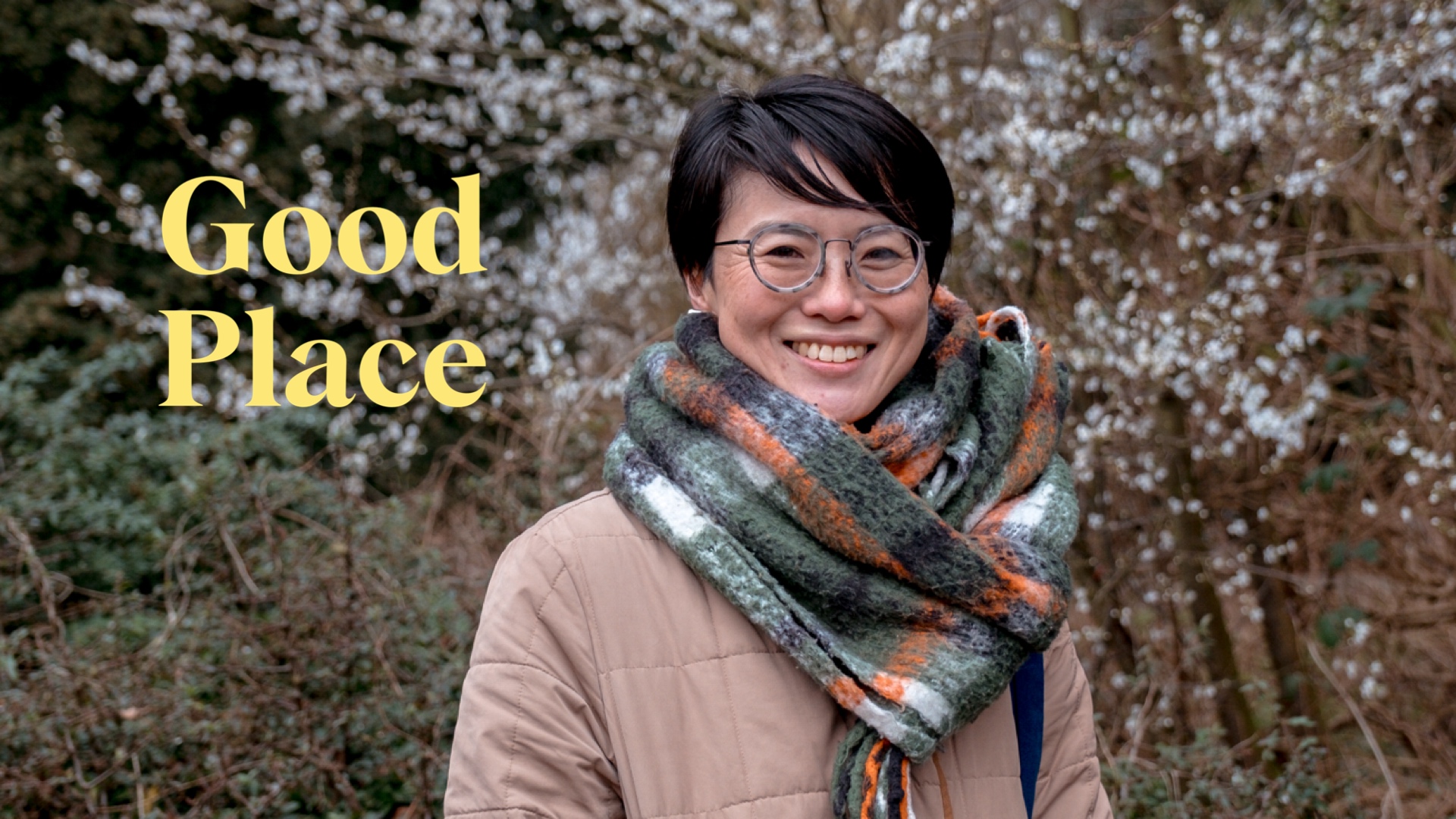
A mother of three on choosing The Hague for its beach, raising bicultural kids who code-switch mid-argument, and why, after five years, she refuses to call herself an expat.
Izumi Saito's connection to the Netherlands started with her husband, not with her. He studied architecture, fell for Dutch design during an early job placement that sent him to the Netherlands for a few months, and came home with a coffee habit and a quiet fondness for the country. Izumi's own first visit, a two-night honeymoon stop in Amsterdam, left her distinctly unimpressed; she'd actually preferred Prague. It took a second trip, a three-month work placement her husband was offered and she managed to negotiate leave from her Japanese employer to join, for the country to click. Cycling around Amsterdam with their toddler daughter strapped to the back of her bike, through an entire spring, did what the honeymoon couldn't.
A visa built for self-employment, and a city chosen by accident
Getting back to the Netherlands for good required threading a specific needle: a Dutch-Japanese treaty that grants residency to self-employed entrepreneurs, regardless of what the business actually does. Izumi's husband, already running an independent practice with Japanese clients willing to keep working with him remotely, qualified easily. The couple picked The Hague almost by default, budget rather than vision, since Amsterdam had become too expensive for the family they wanted to build.
Izumi describes the outcome as one of her better accidents. Her husband still half-dreams of a small Amsterdam apartment. She has no interest in it. The Hague gave her something Amsterdam, Utrecht and Delft, all lovely in their own right, simply can't: an easy beach, dune cycling paths, a landscape that still occasionally surprises her five and a half years in.
A wild vegetable from Fukushima, growing in a Dutch park
One of the smaller, more vivid moments Izumi shared: she found a wild vegetable in a Hague park identical to one she used to forage as a child in rural Fukushima, something you'd need to drive out of Tokyo to find in Japan, let alone stumble across in the Netherlands. She picked some, made a paste, posted it online, and watched other Japanese residents react with disbelief. It's a small thing, but it mapped onto something larger in how she's built a sense of home here: not by replicating Japan wholesale, but by noticing the unexpected overlaps when they appear.
Raising kids who understand cultural relativism better than she does
Izumi's three children, now fifteen, ten and seven, are fully enrolled in local Dutch schools, fluent in Dutch, and increasingly prone to switching out of the family's at-home Japanese policy entirely when they argue with each other, simply because Dutch gives them a wider vocabulary for conflict. She sent her youngest to Saturday Japanese school in Rotterdam for one semester before he asked to quit; she let him, relieved, by her own admission, not to spend every weekend on an early-morning drive.
What stays, deliberately, is food and conduct at home: rice every day, household rules kept closer to Japanese norms even as the children shift into an entirely different register the moment they step outside. The gap between the two shows up in small, charming ways. Asked to explain a Dutch word close to "rude" or "improper," her seven-year-old reached for cross-cultural examples without hesitation: dipping sushi in soy sauce the wrong way, eating pasta with ketchup. Izumi had always assumed her own sense of propriety was simply universal. Watching her children explain it as culturally relative, easily, without anxiety, struck her as its own small education.
Individual versus collective, and the parts worth keeping from each
Izumi was unusually precise about what Dutch individualism gives her that Japan, as a more group-oriented society, doesn't: the sense that who you are doesn't have to be defined first by your role, your family position, your place in a hierarchy. She values that. She also misses specific pieces of the collective fabric Japan builds in instead, children cleaning their own classrooms, serving their own school lunches, absorbing a sense of shared responsibility for public space that she's had to recreate deliberately at home because it isn't modeled at her kids' Dutch school.
Her own summary of the trade-off was the most quotable line of the conversation: if you could mix Japan and the Netherlands and make it half of each, it would be close to perfect. She wasn't being wistful about it. She meant it as a genuine design problem, one she's still actively solving inside her own household, Japanese food and household discipline layered against Dutch directness and a kid's right to ask "why."
Local, not expat
I asked Izumi directly whether she considers herself an expat. Her answer was immediate: no, she sees herself as local. Her children attend the neighborhood school rather than an international one; her closest friends, who've become her chosen family here, happen to be Polish, not Japanese, met through the same school gates rather than through any expat network she never sought out. She speaks Dutch, imperfectly but genuinely, enough to chat with a crossing guard or a local shopkeeper, something she credits directly to watching other foreign residents in Tokyo: the ones who made an effort with Japanese had a visibly richer, more curious relationship with the place than the ones who didn't bother, and she decided early she didn't want to be the second kind here.
Watch the full conversation on YouTube, or listen on Spotify. Want to go deeper into building your own sense of belonging, wherever you live? The Good Place to Start workbook series walks you through it — get it here.
And you? If you could mix two cultures into one place, which two would you choose?