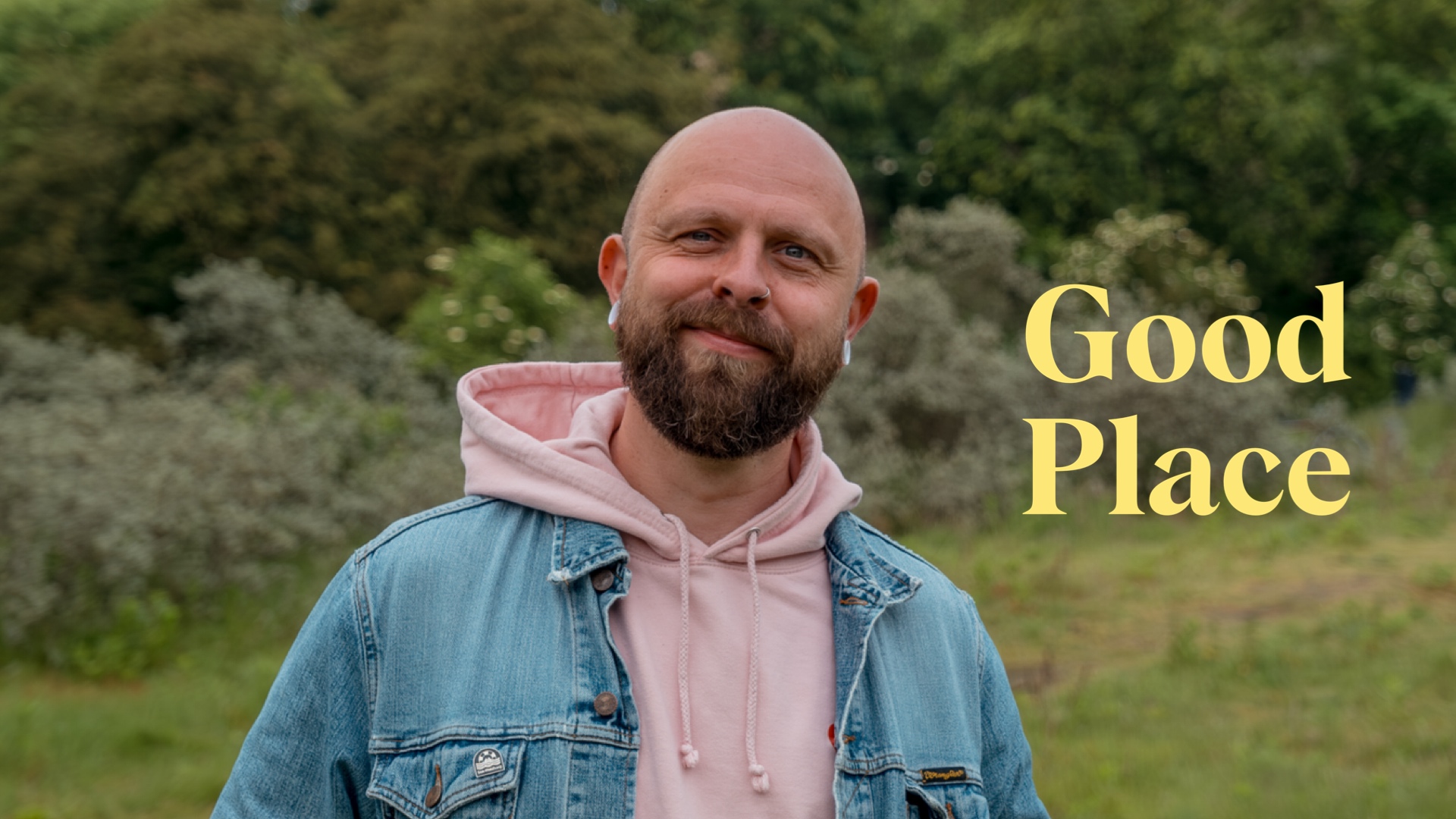
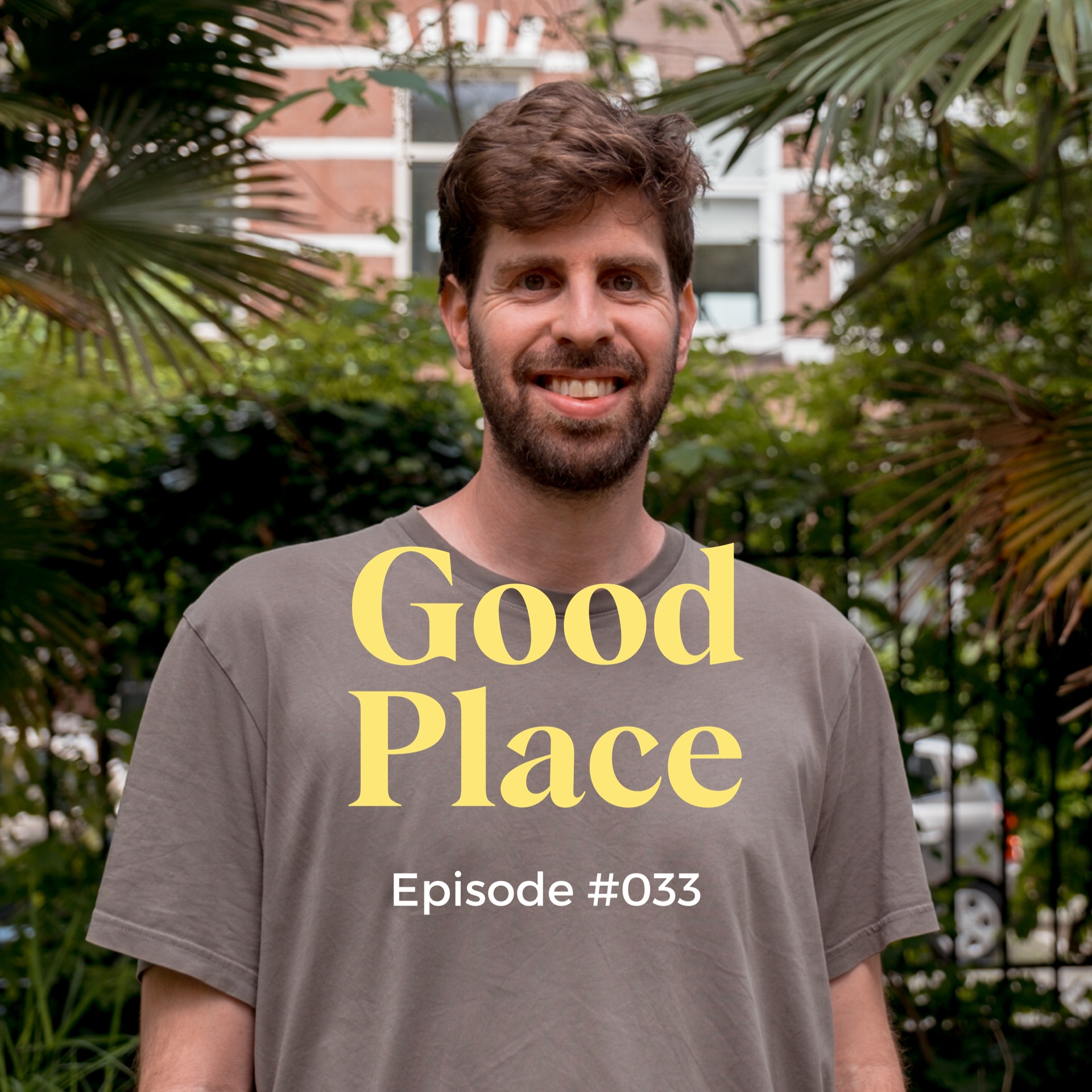
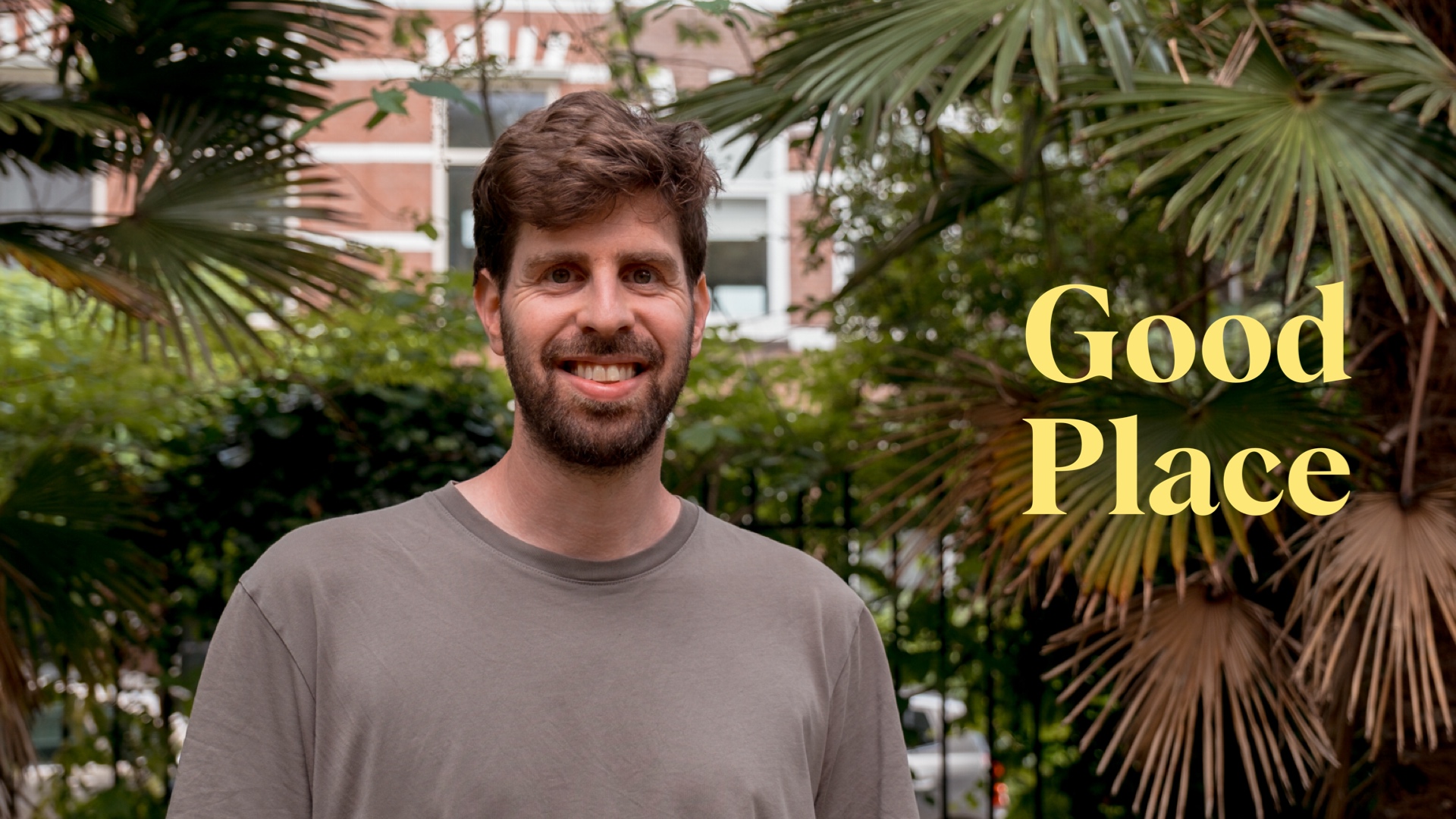
A Tel Aviv-born urban planner on a volunteer-run park, why residents ask for benches to be removed, and why people only use the car because the system makes it the easy choice.
We recorded this on the greenest bench of the series, in a small park in Rotterdam's Delfshaven that is entirely maintained by volunteers. Lior Steinberg, co-founder of the Rotterdam urban agency Humankind, discovered it during Covid, when it got hot indoors and the park turned out to be five or six degrees cooler. "It's not municipality green," he said. "It's natural green, you just let it grow."
From Tel Aviv, via cycling and love
Lior is from Tel Aviv, left Israel about twelve years ago, and has been in Rotterdam for seven. In between he went through Berlin and studied urban planning in Stockholm, then came to Groningen for what was meant to be an exchange semester. He fell in love with the cycling lifestyle, with the way the Dutch live, and, he added when I teased him, with his girlfriend. Ten years on, he's "stuck in a good way": a business, colleagues, a partner, and three bikes. One is fast, one is a city bike he loves, and one is horrible, to lend to visitors.
Sim City and Jane Jacobs
His route into planning started with computers. As a boy he loved Sim City, and he grew up in Tel Aviv walking with his father through the older, walkable part of the city, and then living in a car-centric district built after the war. They wondered who planned it. They didn't know that urban planning was a job. At twenty he found out, googled it, and discovered Jane Jacobs, whose book from the 1960s described the mistakes cities still make. "I thought, oh my God, something needs to be changed, and that's an amazing field."
He had been to Amsterdam as a tourist and found it terrible, because tourists only see the centre. He chose Stockholm over Amsterdam for his studies, and now thinks Amsterdam's centre is a small part of a lovely city.
The least Dutch Dutch city
What he loves about Rotterdam is that it's the least Dutch of the big Dutch cities: rebuilt after the war, diverse, international, with 200-year-old buildings next to social housing from the fifties and sixties. It also shows in the streets, many of them post-war and designed for cars, which makes it a rough, loud city with potential. Asked whether Rotterdam is in a good place, he said it's a city of contradictions: extreme poverty and wealth, creativity and sadness, many cyclists and many drivers. In wealthy areas people have little diversity; in poorer ones they have diversity but poorer access to schools and services. That, he said, is "the future of Europe", so we have to embrace it.
Why benches get removed
The part of the conversation I'll remember is about benches. In almost every project he has worked on, Lior said, residents' demand was to remove benches or not to add new ones, because they were afraid of who might sit on them, especially young people, the so-called hangjongeren. When people sitting on a bench are stigmatised as "hanging", the least wanted get fewer and fewer places to sit, every bench becomes a source of complaints, and municipalities respond by removing them. It's the same group, he pointed out, that complains about young people stuck behind their computers and also about young people outside. We need young people to do stupid things in public space, he said. Sometimes it's annoying; that's part of living in a city.
He compared that with Spain, where there's a bench on every corner and people use them, and playgrounds on every corner too. In the Netherlands, he said, individualism starts at the playground: children playing alone, or next to each other rather than together. I told him that on a month in València, I noticed the same thing.
System, not individuals
What annoys him daily is that sixty to eighty percent of street space goes to cars, in a city with world-class cycling, metro, trams and shared mobility, and trains to Paris in three hours. He doesn't own a car, but he doesn't blame individuals. He blames the system that makes a car easy and, for many people, necessary. When he teaches abroad, he explains that the Dutch don't cycle because they're better or care more about the environment. They cycle because when they open the door, the bike is the faster way. And once you own a car, it's already paid for and parked in front of your door, so why wouldn't you use it?
The mission, he says, isn't fewer cars as such. It's more access for more people, more safely and pleasantly, without spending so much on mobility. That needs denser cities, better green spaces and mixed-use neighbourhoods. Nobody built Amsterdam's centre to have fewer cars; it just has fewer because it wasn't built for them. "When you build it for cars, you get cars. When you build it for people, you get people."
Villages within the city
Lior believes the best cities let you be anonymous in the city and know people in your neighbourhood, the "villages within the city" that Jane Jacobs described. He volunteers in his own neighbourhood, never at work, creating green projects with neighbours who have skills he doesn't, building things or working with plants, while he makes the plan or applies for the subsidy. It builds bonds between people with completely different backgrounds. And the research shows, he said, that people know their neighbours better in streets with less traffic and more public space, and they aren't better people. They just live on streets designed with benches.
Join the meeting
His closing advice to anyone who cares about cities: you have more influence than you think. People who call the municipality to ask for benches to be removed have a lot of influence on public space, so call and ask for a bench. That same evening he was going to a citizen participation meeting in his neighbourhood, where the average age was very high, because young people don't go. We complain but we don't show up. You'll meet great people working for municipalities who face a lot of challenges, and you can be the positive voice. It's easy to complain, and I do too, he said, but he always comes with a solution. "You're almost Dutch," I told him.
I also mentioned, unofficially, that we're working on a Good Place bench, a bench with a purpose, something people can use to meet, listen and share a story. Location matters most, next to a playground, in the sun, with a view. If you'd like one in your city, get in touch.
Watch the full conversation on YouTube, or listen on Spotify. Want to go deeper into building your own sense of belonging, wherever you live? The guided Find Your Good Place series walks you through it: get it here.
And you? When did you last ask your municipality for something instead of against it?