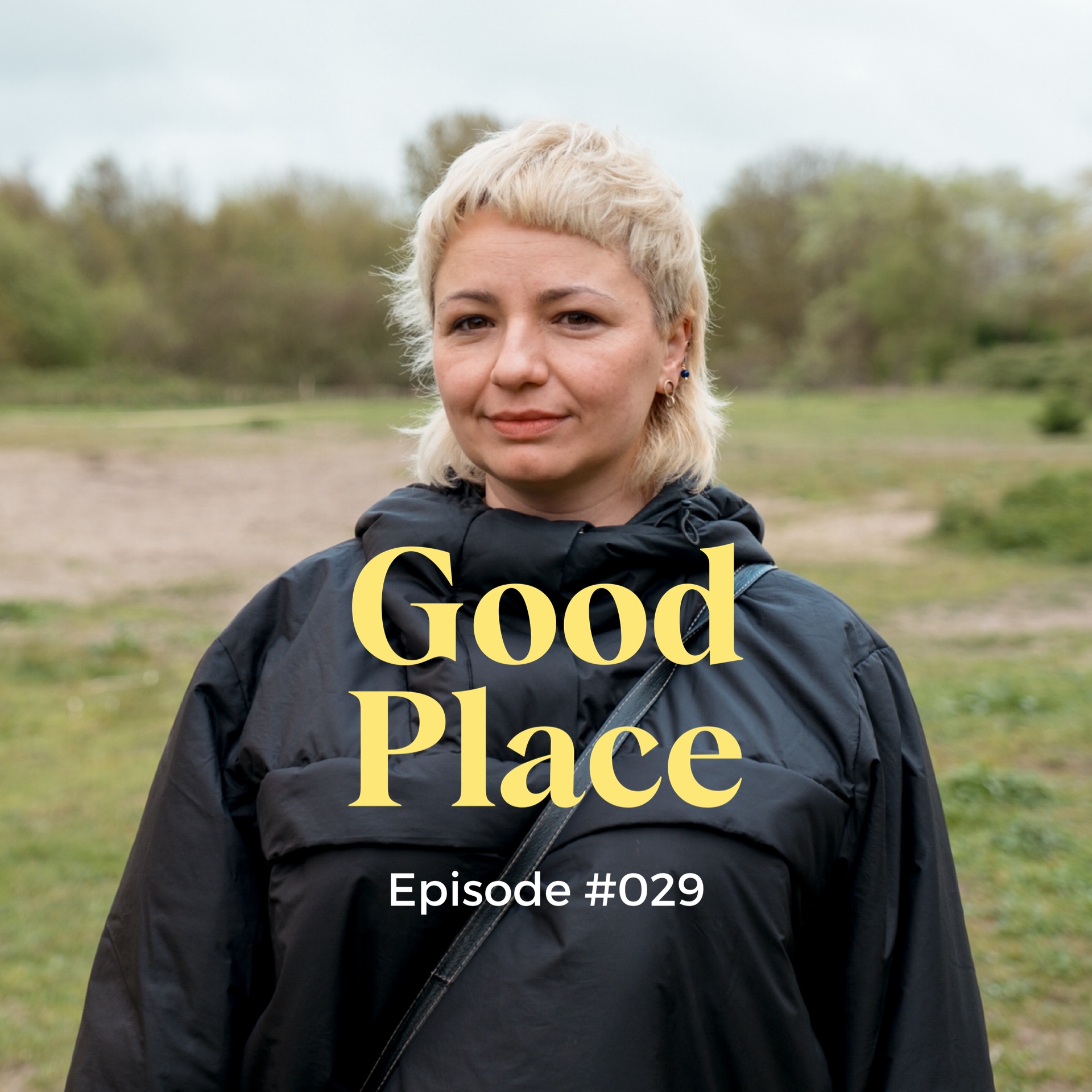
A Polish mother in The Hague on a lifelong Dutch dream, the neighbours and friends who make a place feel safe, and the slow black-and-white portrait project she plans to keep up for a decade.
Gosia is 1.88 metres tall, and she told me, when we sat on the highest bench I've ever recorded on, that for once her feet didn't touch the ground. "Real Dutchies," we agreed. It had been a while since my last episode, and she had been recommended by Izumi, whose episode she'd watched. Gosia lives in the Fruitbuurt, with her husband, two daughters and two Jack Russell terriers.
A dream that began with the sound of a language
Gosia studied Dutch language and culture years ago, and when people ask why, she says she fell in love with the pronunciation. She thought it sounded childish and beautiful. She had been more into German until she met a family in Germany who were in fact Dutch, and heard the language. She spent time in the Netherlands as an au pair and did her master's here. She wanted to come back and had a dream: that her children would speak Dutch to her.
But she met her future husband, who is Polish, just before her master's, and they built a life in Wrocław, a big city in the south-west of Poland. For years, she said, they had jobs, friends and colleagues, and still there was a feeling that something was missing. When he was offered a job in the Netherlands, it wasn't really a question. "We've been waiting for it almost our whole life." The Hague wasn't the plan, but the job was here, and she liked how it sits between Rotterdam and Amsterdam, with the dunes close by.
A neighbourhood that doesn't pretend to be anything else
Their first rented flat was in Scheveningen, close to the dunes, which she loved, but it was crowded and full of tourists. She wanted somewhere more normal, where children could play in the street and walk to school alone. A year later they rented a flat in the Fruitbuurt, a hundred metres from where they live now, and then they bought.
What she loves about it is the neighbours. They are mostly older, "very hippie style, free in their minds", and patient with the dogs. There are families with children playing in the street. It's green, was built in the 1930s, and on summer evenings, with the terrace door open, she can hear quiet conversations from the neighbours and then complete stillness. That's amazing in the middle of a city, she said.
The older couple living below them, she told me, chat with her in the doorway for half an hour at a time. They have an old motorbike, the kind you see in films of the Second World War, and still go camping on it in their seventies. Her husband has been doing a language app every day for three years, mostly so he can talk to them.
The game of imagining somewhere else
I recognised something when Gosia described a habit of hers. She plays a game in her head: maybe in another city, or another country, she'd be happier. Stockholm has been on her list. Every time she plays the game, she comes back to The Hague. In Wrocław, she did the same on a smaller scale, and they moved eight times in seven years, trying out different parts of the city. When you live in different circumstances among different people, she said, you become a different person. She's decided she's had enough of that. Her daughters love it here. They can't imagine another way of living, and her younger daughter started in a Dutch school the day they arrived, aged four.
The one thing she misses is large cultural events, like festivals, though Rotterdam and Amsterdam are a train ride away. Her everyday life, she says, is compact.
Trust, and a support team
When I asked what a good place is, she started with relationships and connection, and then she named something specific: trusting the system. In the Netherlands, she said, people smile at you in the street, and she senses that they trust the police and hospitals more, and are less frustrated. That's what she missed in Poland.
The second layer is the friends they've found, who are, in effect, a small support team, since they have no grandparents or aunts nearby. They're families from their daughters' first days at school: Izumi's, a Polish friend's, a Bulgarian family, another Polish one. Their daughters became best friends, and so did the parents. Without them, Gosia said, she doesn't think she'd feel so confident.
She was candid about what moving did to her. She had worried that people on the street might think they didn't belong, though no one ever gave her any reason. It had an effect on her all the same. Over time, it changed to: I'm not going to care about it. Life became so full of people and conversations that it stopped mattering.
Starting from school
Gosia's work followed from those neighbours. She wasn't sure where to start with a degree in Dutch and years of not using it, and a neighbour's suggestion led her to look at schools. She now works as an assistant at a school, alongside a psychologist, observing and testing children and translating conversations between parents and the school. She loves it. A few years ago she didn't much enjoy being around children, she said, and something changed. "They are the best teachers."
A portrait every six months
The project she told me about is deliberately small. Gosia is returning to photography, which was a passion in Poland, and she shoots analogue. She's increasingly drawn to portraits, because of the time you spend with the person in front of you. The idea is to photograph her friends' families at her house, every six months, in the same place, in black and white, and develop the pictures in a darkroom her husband will build for her. Then in ten years, she'll have a record of how they've all changed: whether they were having a difficult time at work, or an argument, or were in a good place that day. The people are her Hague family: Izumi's, Natalia's, the Bulgarian family, and another Polish family. I suggested she include her neighbours, and she liked the idea.
She has no ambitions for it yet, she says, and is a little afraid of her own. When she suggested it at Christmas dinner, everyone agreed, and then nothing happened. "I stopped believing in spontaneous projects," she told me, and now she's become very Dutch: she's put it in the diary.
The best possible place
Asked if she was in a good place, Gosia didn't hesitate: "the best possible place". They'll only visit Stockholm, she said. They aren't going anywhere for a long time, certainly not in the next six years.
Watch the full conversation on YouTube, or listen on Spotify. Want to go deeper into building your own sense of belonging, wherever you live? The guided Find Your Good Place series walks you through it: get it here.
And you? Who would be in your ten-year portrait?