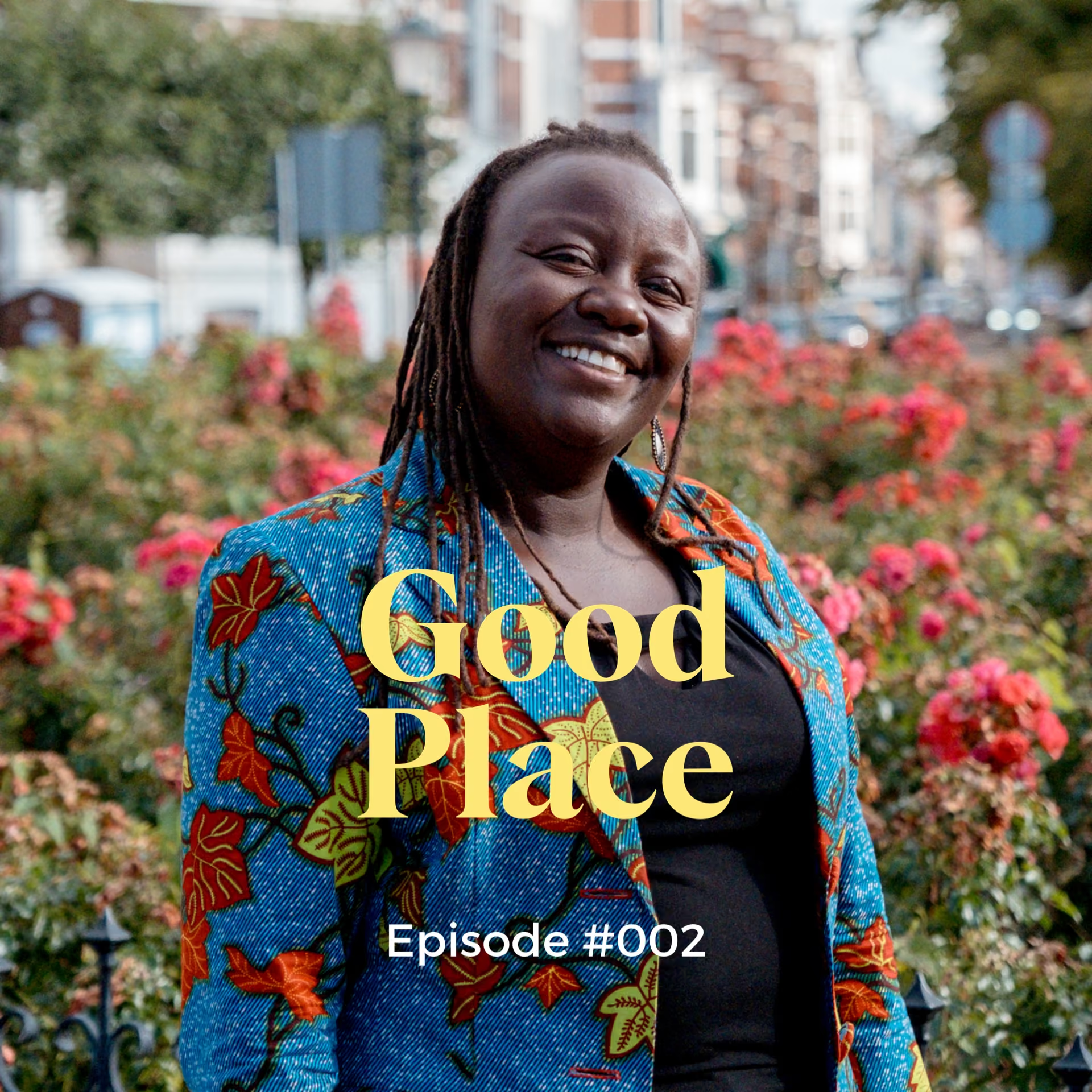
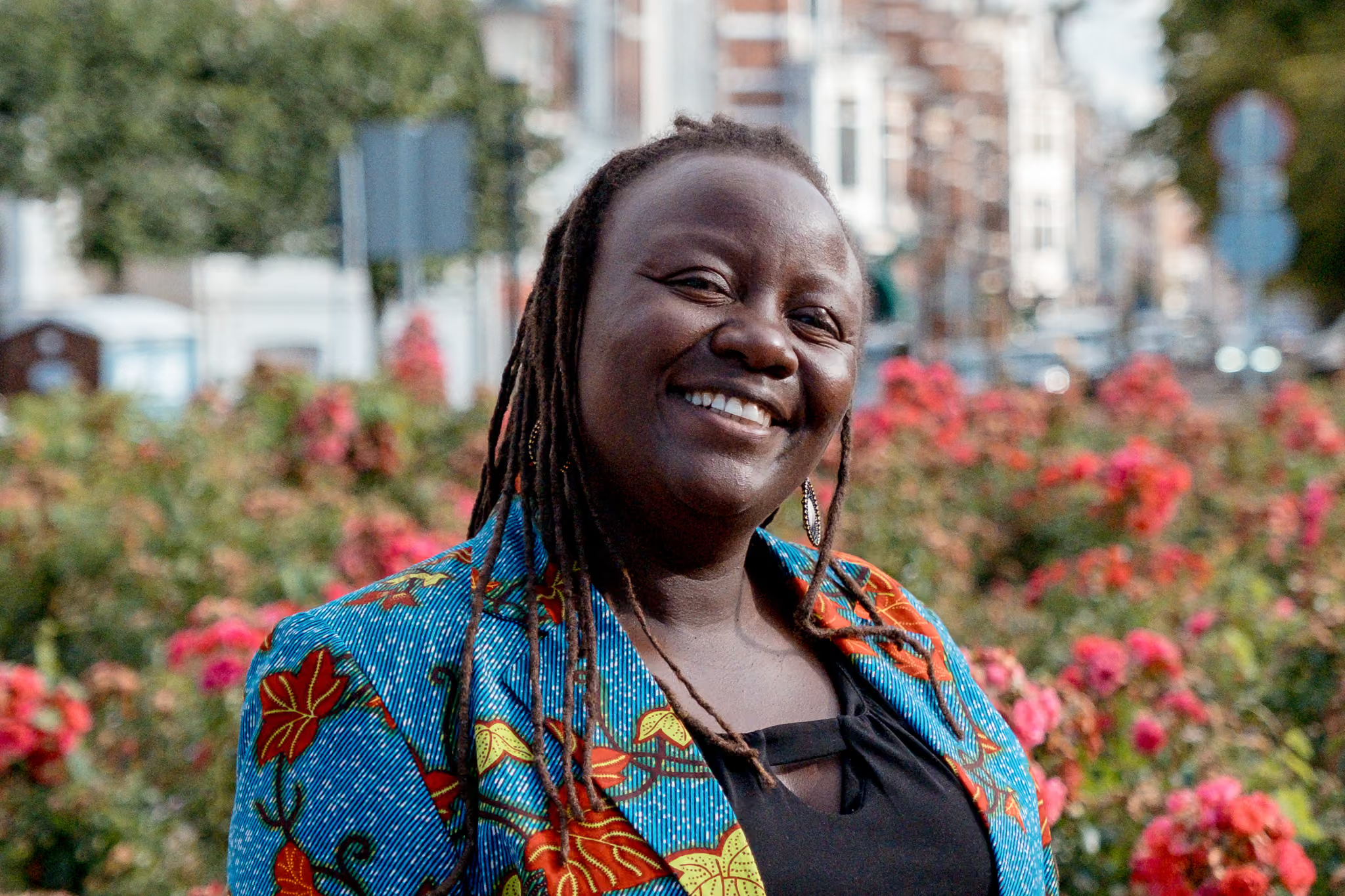
Some people move once and spend the rest of their life explaining the decision. Elizabeth Njeru has moved four times in twenty-four years, through three Dutch cities, and she explains it more simply than you’d expect: life happens, and then you make decisions.
We sat down on her public bench in a busy square near Café Momo in The Hague. Elizabeth was born and raised in Embu, Kenya, and came to the Netherlands for a master’s degree after falling in love with a Dutch exchange student she met at university. That relationship ended, but the move had already reshaped her life. Utrecht became Amsterdam became The Hague, each one for a reason she could name.
Two moves, one pattern
Elizabeth’s path to the Netherlands was love. Her path within it, when we traced it together, turned out to be love too, twice over. She left Utrecht for Amsterdam wanting a more anonymous life, more excitement, more places where she didn’t already know every street and café. She left Amsterdam for The Hague for a different reason: a partner whose job meant hours of commuting and travel. Moving in together gave them back the time they’d been spending on trains.
What struck me was less the pattern itself than how she described it once she heard it said back to her. She’d never framed her own story that way, mobility as something love kept setting in motion. “That quite summarizes it,” she said, half-laughing. Not everyone gets to hear their own life read back to them as a shape.
A city chosen for its options
Ask Elizabeth what she loves about The Hague and one word comes up more than any other: options. Restaurants, cycling, cafés, the ability to meet a friend after work without planning it days in advance. “I really love the freedom to see other people, to go to restaurants, to cycle.” Put her in a big house in the middle of nowhere, she says, and she’d enjoy it for a while and then start going crazy.
The Hague gave her something Amsterdam couldn’t: a serious beach, wide and varied, a short cycle from her door, backed by dunes and green space. During the pandemic, when nothing else was open, that proximity became the difference between feeling trapped in a city and having somewhere to breathe. Amsterdam’s version of escape meant a tram, then a train, then arriving already tired. Here, she says, you just go.
It’s a small reminder that walkability and cyclability aren’t only about convenience. They’re about how much of a city’s options you can actually reach on an ordinary day, without the trip itself becoming the obstacle.
What a new city doesn’t hand you
Arriving in The Hague meant starting from nothing, even after fifteen years in the Netherlands. “You don’t really have a network, you don’t have friends, you don’t know where the restaurants are.” She asked her partner’s colleagues for restaurant tips and got a short list of three. They tried the first, loved the food, became friends with the chef, and never made it to the other two.
It’s a small story, but it says something true about settling somewhere: belonging rarely arrives as a plan. It arrives as one good meal, one conversation that goes somewhere, repeated until a new city stops feeling foreign.
Home, and the place that isn’t
Elizabeth returns to Kenya every year. Her parents and sisters are still there, and she describes the trips with real warmth, Mount Kenya visible from her parents’ house, a landscape she loves, people she misses. But when she says the word “home,” she means Holland. “This is home,” she told me, no hesitation.
What she misses about Kenya is specific: her family, mostly, and a different texture of life. What she doesn’t miss is just as specific. Everything in Kenya requires a plan, she said, down to a walk in the forest. In the Netherlands, she can decide on a whim to cycle somewhere and simply go. She also named something less obvious: trust in systems. Apply for an ID card here and you’re told it will be ready in three days, and it is. That certainty, she said, is something she’s come to rely on and would miss badly if it disappeared.
Her family, for their part, finds her mobility bewildering. In Kenya, she explained, you build your family home and that’s your home, full stop. The idea of moving between cities every few years strikes them as strange. “They are planted,” she said. “They can’t move.” She can, and has, four times.
The work of helping other people land
Elizabeth works as a coach for internationals, professionals who’ve moved countries and are navigating careers, visas, or simply a culture that runs on different rules than the one they grew up with. She’s drawn to this work because she’s lived it: the extra layer of difficulty that comes from being new, on top of whatever challenge someone would already be facing at home.
The patterns she sees are specific and small. A client whose Dutch colleagues never invite them home after work, and doesn’t know if that’s personal or cultural. Someone used to walking into a hospital who now has to book a ten-minute appointment with a GP and finds the time allotted barely enough to explain what’s wrong. Visa and paperwork questions sitting underneath career questions, quietly determining who gets taken seriously and who doesn’t.
What those stories share, she said, is insecurity: not knowing how to solve your own problems because the ground rules are unfamiliar. Her job isn’t to reassure people that everything is fine. It’s to help them see clearly enough to make their own decision. “We always have options,” she said, “as long as you’re prepared to face whatever problem or fear you’re dealing with.”
Systems, freedom, and the balance between them
Our conversation kept circling back to one tension: how much structure a good life needs, and how much it costs. Elizabeth likes that the Netherlands is organized, that she can count on things working the way they’re supposed to. But she was equally clear that systems have to keep adapting to the people living inside them, not the other way around. Inclusion, to her, means giving people more options, not a single approved path and the door otherwise.
She was careful to draw a line. She wants healthcare and housing and food security available to everyone. She doesn’t want a system so total that it decides her salary or her freedom to travel. “I also want to be able to travel if I want to, or to go to school if I want to, or to wear the clothes I want to wear.” The options she keeps returning to aren’t luxuries to her. They’re the test of whether a system is actually serving the people in it.
In a good place, and still adapting
When I asked if she was in a good place, her answer came without hesitation, fresh off a month-long holiday in Kenya that had left her properly rested for the first time in a while. “I’m in a very good place. And The Hague is a fantastic place.”
On whether the world is in a good place, she was more careful. “The world is in transition,” she said, unwilling to call it good or bad, only unresolved. She’s hopeful about inclusion as a direction, frustrated that people with real contributions to make are still shut out by systems rather than welcomed by them.
Her closing thought stayed with me more than anything else she said. People get stuck, she told me, not because their situation is unbearable but because they keep trying to force an old version of happiness onto a life that has already moved on. The alternative isn’t comfort. It’s willingness: to adapt, to notice when something has changed, and to let yourself change with it.
Watch the full conversation on YouTube, or listen on Spotify. Want to go deeper into building your own sense of belonging, wherever you live? The Good Place to Start workbook series walks you through it: get it here.